
Get the Full Report in Your Inbox
of GenAI projects will overrun their budget due to poor architectural choices and lack of operational know-how.

- How to balance model accuracy, performance, and cost trade-offs
- The hidden cost drivers most teams miss
- How AI gateways and model routing reduce waste
- Strategies for governance, pricing, and cost transparency

.webp)
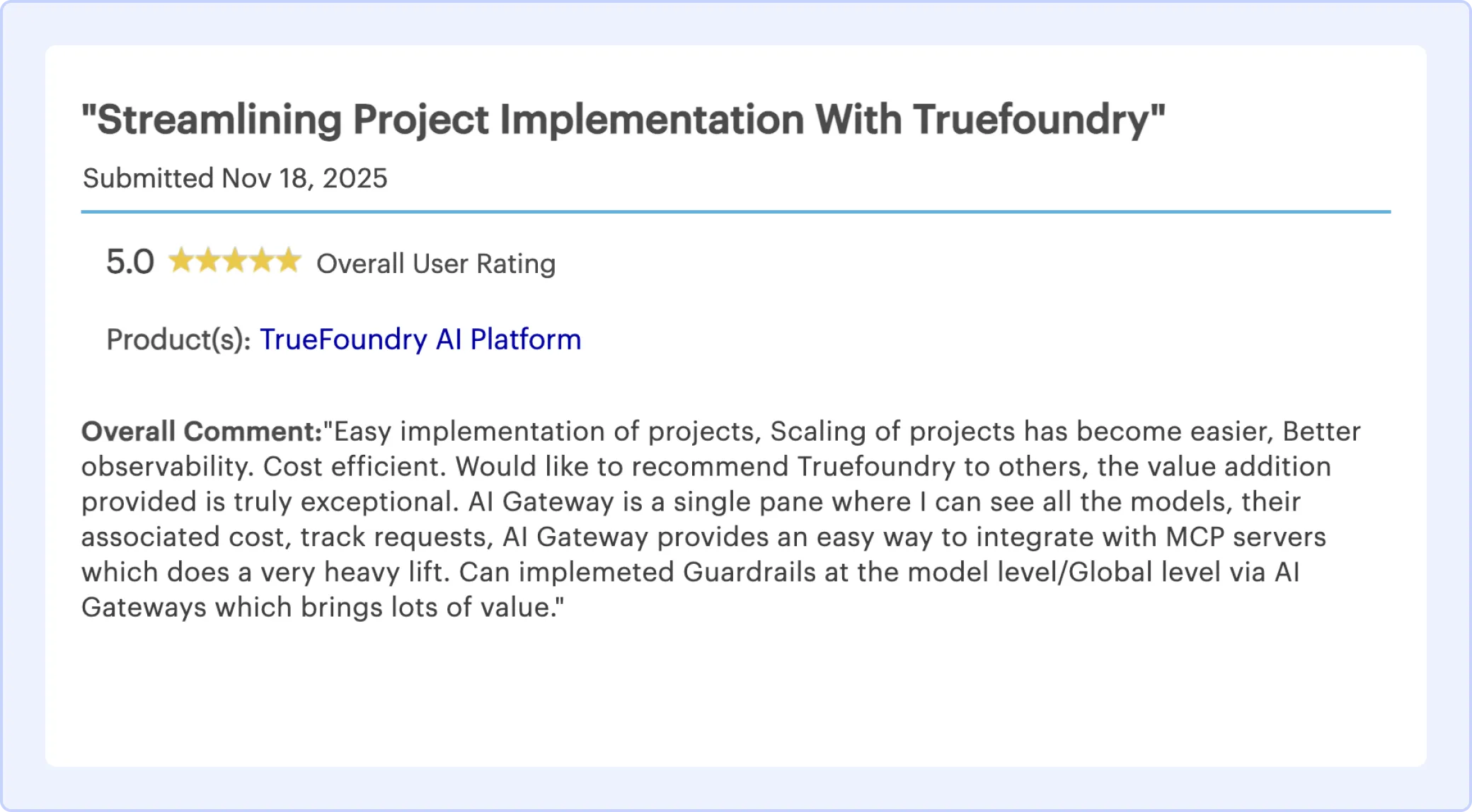
TrueFoundry is the AI Gateway platform of choice for leading enterprises and Fortune 500 companies. 96% of reviewers are likely to recommend TrueFoundry and our users have rated us 4.9 for ease of deployment, administration, and maintenance.
As generative AI moves from experimentation to production, enterprises are facing a new and unexpected challenge: AI cost optimization.
While early pilots often appear inexpensive, scaling AI systems introduces a completely different cost dynamic. In our view, the report indicates that organizations underestimate the complexity of running production-grade AI, leading to rising generative AI cost, budget overruns, and inefficient deployments.
The core issue lies in how AI systems operate. Unlike traditional software, generative AI workloads are usage-driven and non-linear. A single user request can trigger multiple model calls, tool executions, and retrieval steps—especially in agentic workflows. This makes costs harder to predict and significantly more volatile.
At the same time, pricing models across providers are rapidly evolving. Enterprises must navigate a mix of token-based pricing, API usage fees, subscription tiers, and even outcome-based pricing in some cases. Without clear visibility, comparing costs across vendors becomes extremely difficult.
This is where architectural decisions start to matter.
Not every use case requires the most advanced (and expensive) model. Choosing the right model for each task is one of the fastest ways to achieve AI cost reduction while maintaining performance.
Without proper monitoring, AI usage can grow unchecked. Teams need visibility into token usage, cost per request, and model performance to make informed decisions.
A new category of infrastructure—AI gateways—is emerging to address this challenge. These systems act as a control layer, enabling organizations to route requests to the most cost-efficient models, enforce usage policies, and optimize performance in real time.
In our view, Gartner specifically highlights this category as critical to cost optimization and names TrueFoundry as a vendor offering AI gateway tools in the space, which we feel is signaling strong enterprise adoption of this architectural pattern.
Beyond infrastructure, there’s also a human factor. Developers and end users often lack awareness of how their usage patterns impact costs. Educating teams on efficient prompting, model selection, and responsible usage is becoming a critical part of AI cost management.
Enterprises that build cost-aware AI systems today will be better positioned to scale faster, experiment more, and unlock long-term value from AI investments.
If you're building or scaling AI applications, understanding these cost dynamics is essential to proving the ROI of these investments.
Gartner, 10 Best Practices for Optimizing Generative and Agentic AI Costs, By Arun
Chandrasekaran et. al, 20 March 2026
GARTNER is a trademark of Gartner, Inc. and/or its affiliates.
Gartner does not endorse any company, vendor, product or service depicted in its publications, and does not advise technology users to select only those vendors with the highest ratings or other designation. Gartner publications consist of the opinions of Gartner’s business and technology insights organization and should not be construed as statements of fact. Gartner disclaims all warranties, expressed or implied, with respect to this publication, including any warranties of merchantability or fitness for a particular purpose.