May 22, 2026
|
5 min read


Get instant access to a live TrueFoundry environment. Deploy models, route LLM traffic, and explore the full platform — your sandbox is ready in seconds, no credit card required.



Updated: December 7, 2025

Blazingly fast way to build, track and deploy your models!
The EU AI Act has transformed AI compliance from a legal concern into a core platform engineering challenge. For enterprise leaders responsible for AI systems, It now directly affects:
Modern AI compliance cannot be achieved with process documents alone -it requires infrastructure that enforces governance by design.
The central question enterprises now face is: How do we build AI systems that ship safely and remain compliant at scale without slowing innovation?
The answer is increasingly clear:
compliance must be built into AI infrastructure, across the full lifecycle, not bolted onto applications one by one.
The EU AI Act introduces a risk-based regulatory framework for AI systems, with stricter obligations applied to high-risk and general-purpose AI deployments. For enterprise AI leaders, the law translates into very specific technical expectations, not high-level ethical guidance.
At its core, the regulation requires that organizations operating regulated AI systems must be able to demonstrate:
In summary, the EU AI Act reframes compliance as an engineering discipline - demanding transparency, governance, and operational safety controls be designed directly into AI systems. Meeting its requirements requires infrastructure that can continuously enforce standards across the entire AI lifecycle, rather than piecemeal controls layered onto individual applications.
A common first reaction to regulatory pressure is attempting to “solve compliance at the application layer.” Teams adapt existing AI-powered services with custom controls:
This approach may appear workable during early adoption, but it fails rapidly at enterprise scale. As the number of AI services, models, LLM providers, and internal agent workflows grows, governance becomes fragmented and inconsistent.
Compliance cannot be reliably maintained when controls are distributed across hundreds of application codebases owned by different teams with varying maturity, priorities, and interpretations of policy.
Application-driven compliance results in systemic weaknesses:
At scale, application-layer compliance becomes not just error-prone, it becomes unmanageable. Governance requirements demand centralization, standardization, and automation at the infrastructure level, rather than piecemeal enforcement scattered throughout application code.
To address fragmentation at the application layer, enterprises are increasingly moving toward a runtime control-plane architecture for AI - a centralized gateway layer through which all model traffic flows.
Instead of embedding safety, privacy, and compliance logic inside every service, this approach places governance at the infrastructure edge of AI usage.
A control plane operates as the single enforcement point for inference-time policies across all applications, models, and providers. It enables organizations to apply compliance once and enforce it everywhere.
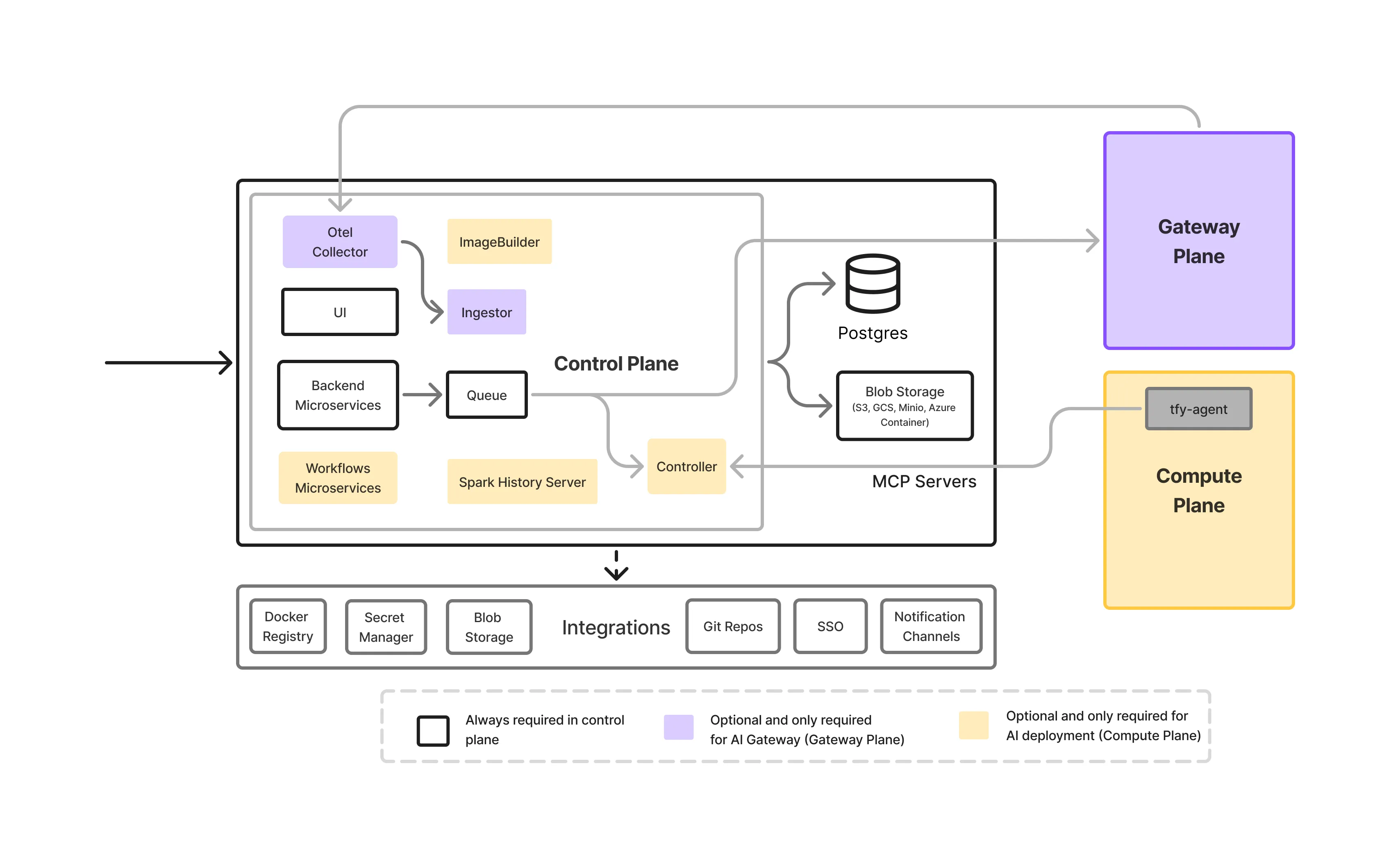
Key capabilities include:
By consolidating all inference traffic into one system layer, enterprises regain visibility and uniform control:
For inference governance, this architectural shift is essential. It transforms compliance from distributed application hacks into continuous infrastructure enforcement.
However, while control planes solve safety and transparency challenges at runtime, they do not address the most complex regulatory obligations introduced by the EU AI Act - those related to the training lifecycle, risk classification, documentation, evaluation, and approvals of high-risk AI systems.
Runtime governance answers how AI is used.
It does not ensure governance for:
Meeting these obligations requires governance across the full AI lifecycle, not just at inference time.
That is why enterprises need more than a control plane - they need a governance platform that integrates directly into data pipelines, training workflows, and deployment systems.

The EU AI Act makes one thing clear: compliance is not a runtime-only concern. It applies to every phase in the AI lifecycle - from the moment data is collected to how predictions are monitored long after deployment.
While an AI control plane governs how models are used, true regulatory compliance depends equally on how models are built, validated, deployed, and continuously monitored. These lifecycle obligations cannot be satisfied at the gateway alone.
Enter the concept of full-stack AI governance - an architecture where compliance flows across integrated layers rather than existing as isolated point solutions.
In practice, this means enterprises need governance mechanisms at four key levels:
Data is the foundation of regulated AI.
Compliance begins where data enters the system:
Without this layer, organizations cannot demonstrate that the training data behind regulated models meets quality and fairness standards.
Once data is prepared, governance must extend to model training and evaluation:
This creates a transparent technical record demonstrating that models were tested, validated, and reviewed before reaching production — which is essential for high-risk classifications under the EU AI Act.
Deployment is where technical control becomes regulatory accountability.
For high-risk AI systems, simply allowing teams to push models to production is unacceptable. Instead, governance requires:
This layer operationalizes the human-in-the-loop requirement — ensuring that regulated models cannot go live without explicit oversight and signoff.
Compliance does not stop when a model ships.
Production governance requires:
Monitoring dashboards must be capable of serving both engineering teams and compliance auditors with the same underlying telemetry turning governance into a measurable operational activity rather than periodic documentation.
When combined with a runtime AI control plane, these lifecycle layers form a true enterprise compliance fabric - governance that is systemic, continuous, and automated rather than reactive or manual. This integrated architecture eliminates the need for fragmented controls and enables enterprises to confidently scale AI adoption into regulated domains.
But infrastructure alone is not enough - tooling must make this governance usable for real engineering organizations.
TrueFoundry is designed to operationalize AI governance across every compliance layer not as a bolt-on policy checklist, but as built-in infrastructure.
Rather than treating safety, documentation, approvals, and monitoring as parallel manual processes, TrueFoundry embeds them directly into the ML development lifecycle enabling teams to move fast while remaining aligned with regulatory obligations. Below is how key EU AI Act requirements become platform-native workflows inside TrueFoundry.
Compliance begins before training ever starts. TrueFoundry treats datasets as versioned, auditable assets rather than ad–hoc files or notebook artefacts:
This ensures teams can verify and prove that training data is representative and systematically reviewed, rather than assembled informally.
Each model deployed with TrueFoundry maintains complete lineage back to the originating data and pipelines:
Evaluation results are stored as artifacts attached to the model version, creating a defensible compliance record far stronger than detached documents or spreadsheets.
Regulated AI demands more than CI automated deployments. TrueFoundry implements governance directly at release-time:
This converts the EU AI Act’s human oversight requirement into a tangible operational control rather than an aspirational policy.
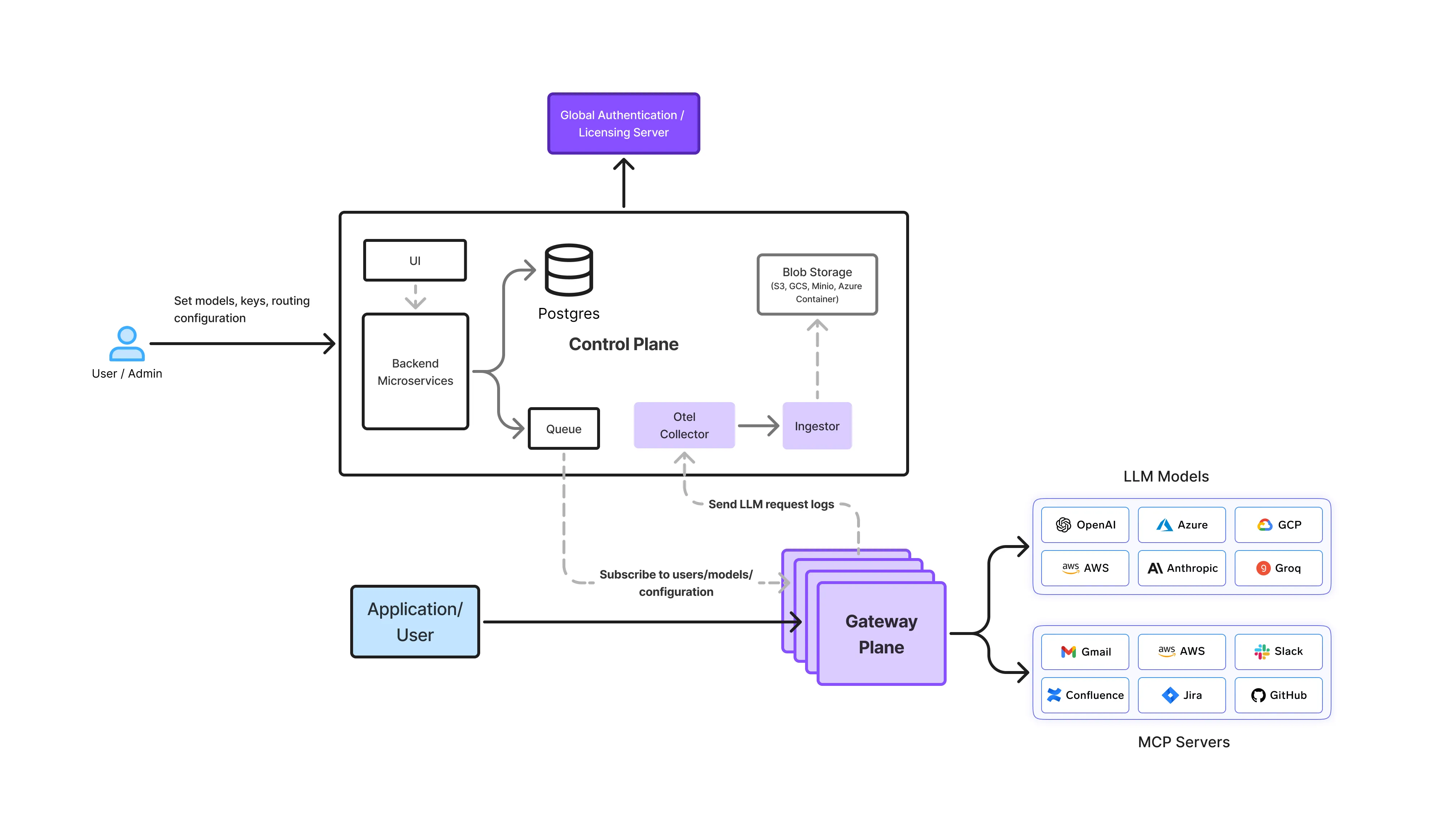
While lifecycle governance ensures safe development and release, effective compliance requires active control during live AI usage. TrueFoundry’s integrated AI Gateway and Agent Gateway provide centralized runtime enforcement:
Every runtime request is correlated back to:
User → Application → Model → Dataset → Training Pipeline
This chain of custody provides continuous end-to-end traceability - a critical compliance capability many organizations lack once models leave experimentation stages and enter distributed production systems.
Deployment is not the endpoint. TrueFoundry embeds compliance verification into production monitoring:
These dashboards enable both:
Continuous observation replaces static certifications - aligning exactly with the EU AI Act’s emphasis on operational accountability.
Enterprise AI deployments must align not only with governance principles but also with data sovereignty and infrastructure controls. TrueFoundry supports compliant execution environments via:
These capabilities enable enterprises to meet EU data localization obligations and internal security standards without fragmenting platforms by geography. By combining:
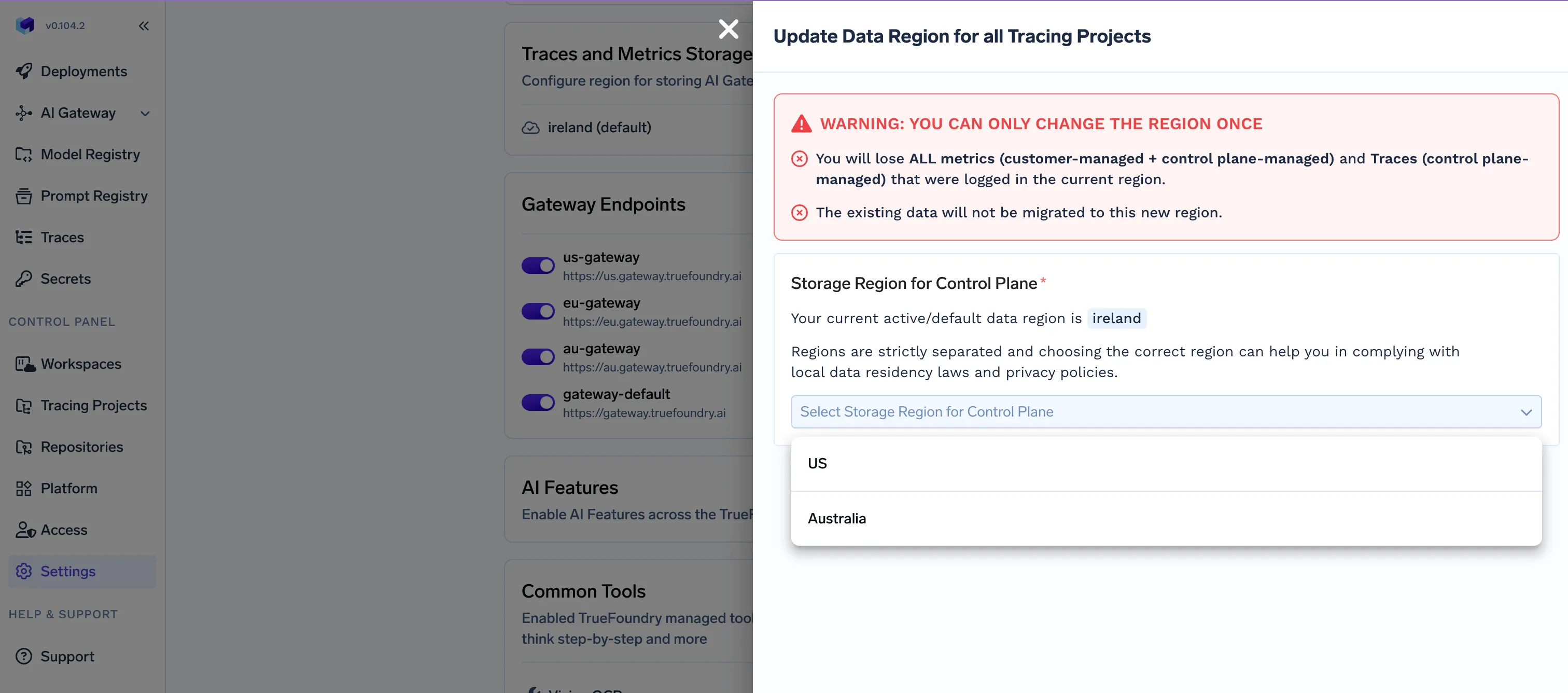
TrueFoundry delivers a unified AI governance fabric - eliminating the need for disconnected tooling and compliance workarounds across regulated AI environments.
The EU AI Act does not slow down AI innovation - it raises the bar for how AI must be built and operated at scale.
For enterprise leaders, the path forward is clear: compliance cannot be treated as a legal afterthought or an application-level patch. It must be engineered directly into the AI platform itself from governed data pipelines and model lineage to centralized runtime controls and continuous monitoring. Organizations that embrace this infrastructure-first approach will not only meet regulatory requirements more efficiently, they will also gain stronger operational discipline, higher customer trust, and faster enterprise adoption. Responsible AI is no longer a differentiator, it is becoming the foundation for sustainable scale.
By embedding governance and oversight across the full AI lifecycle, platforms like TrueFoundry enable teams to innovate confidently within regulated environments- building AI systems that are not only powerful, but also transparent, accountable, and compliant by design.
TrueFoundry AI Gateway delivers ~3–4 ms latency, handles 350+ RPS on 1 vCPU, scales horizontally with ease, and is production-ready, while LiteLLM suffers from high latency, struggles beyond moderate RPS, lacks built-in scaling, and is best for light or prototype workloads.




The latest news, articles, and resources sent to your inbox
© 2026 All rights reserved.






.png)

.png)