


November 13, 2025
|
5 min read


Get instant access to a live TrueFoundry environment. Deploy models, route LLM traffic, and explore the full platform — your sandbox is ready in seconds, no credit card required.



Updated: May 26, 2026

Blazingly fast way to build, track and deploy your models!
Every enterprise experimenting with AI agents is running into the same wall: connecting agents to tools is easy but controlling, securing, and observing those interactions at scale is nearly impossible with today’s infrastructure.
You can build a brilliant agent.
You can expose powerful tools.
You can wire together MCP- or A2A-based systems.
But once agents start orchestrating multi-step workflows, call external APIs, spawn other agents, or trigger long-running tasks, you suddenly hit problems no API gateway or reverse proxy was ever designed to handle:
This is the new distributed systems frontier for AI.
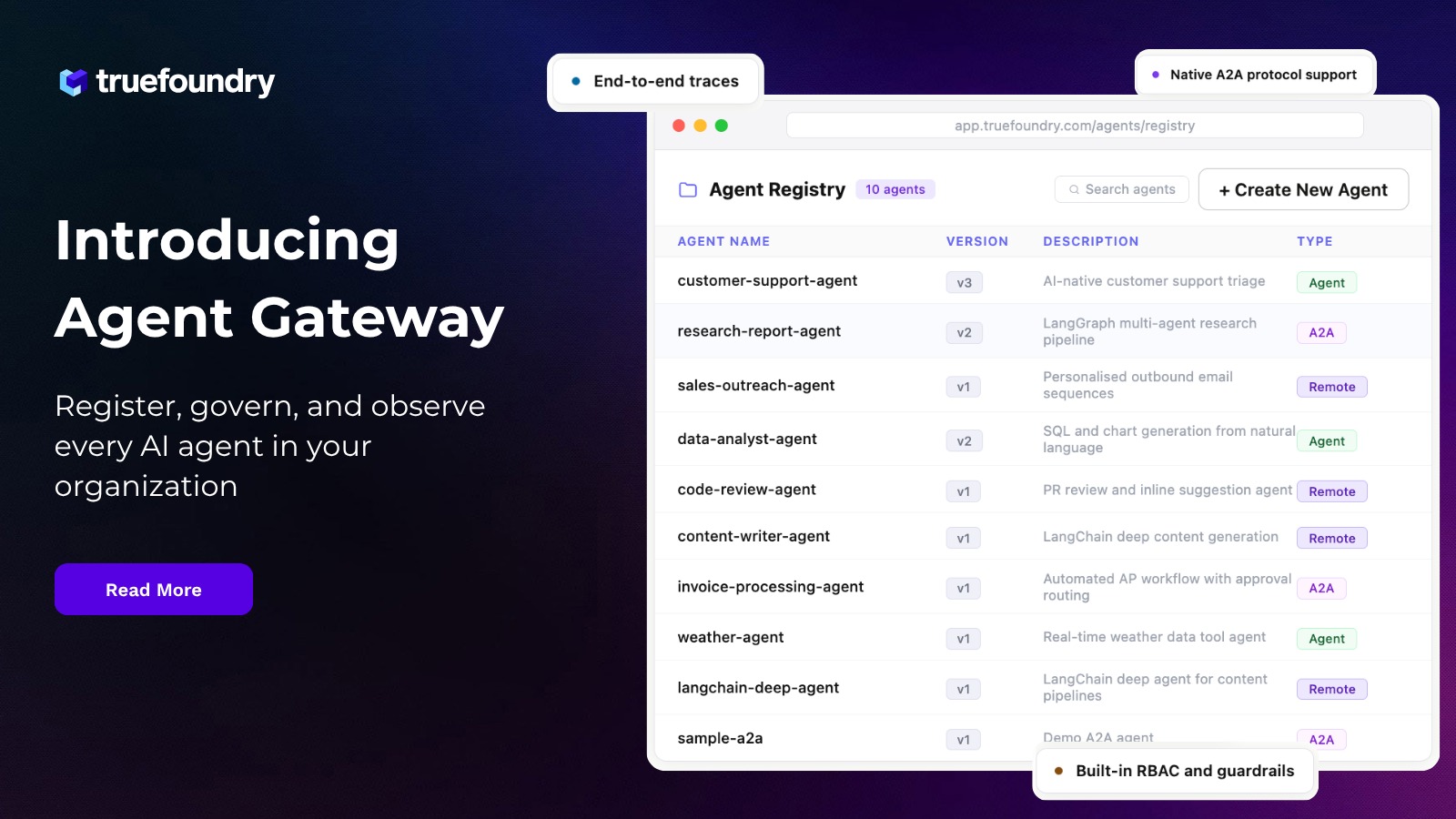
And it’s exactly why we launched the Truefoundry AI Agent Gateway matters.
API gateways were built for service-to-service REST traffic—stateless, request/response, per-call routing.
Agentic systems are the opposite:
1. Agents speak stateful protocols (MCP, A2A, JSON-RPC)
They maintain sessions, context, and long-running streams. REST gateways can't track session identity or multiplex/demultiplex multi-agent conversations.
2. Tools can initiate events back to agents
Agents need push messages (SSE, streaming updates). Reverse proxies break because they don't understand bidirectional flows.
3. Agent workloads “fan out” massively
A single request like “Find all tools that can analyze customer risk” may need to query 10 or 20 backend MCP tool servers, then return a unified result—not possible in commodity gateways.
4. Agents require dynamic entitlements and guardrails
Every agent persona (ComplianceAgent, PaymentsAgent, FraudAgent) needs different access scopes. API gateways cannot enforce tool-level RBAC for machine reasoning systems.
5. Agents require observability at the semantic level—not just metrics
Developers and auditors need to answer:
API gateways simply do not have this context.
Agentic systems need a new category of infrastructure:
A stateful, protocol-aware, LLM-aware gateway.
That’s exactly what Truefoundry has built
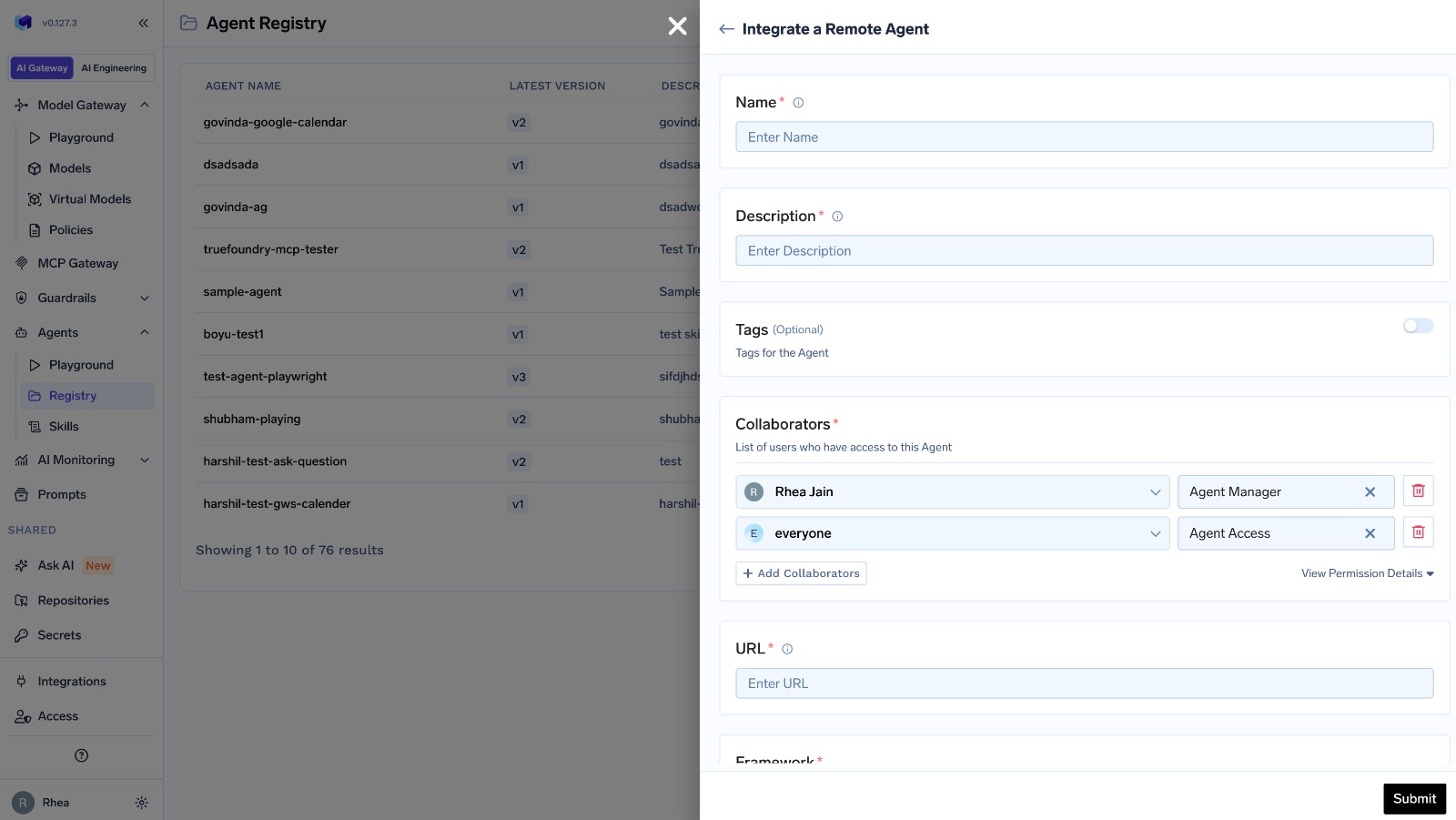
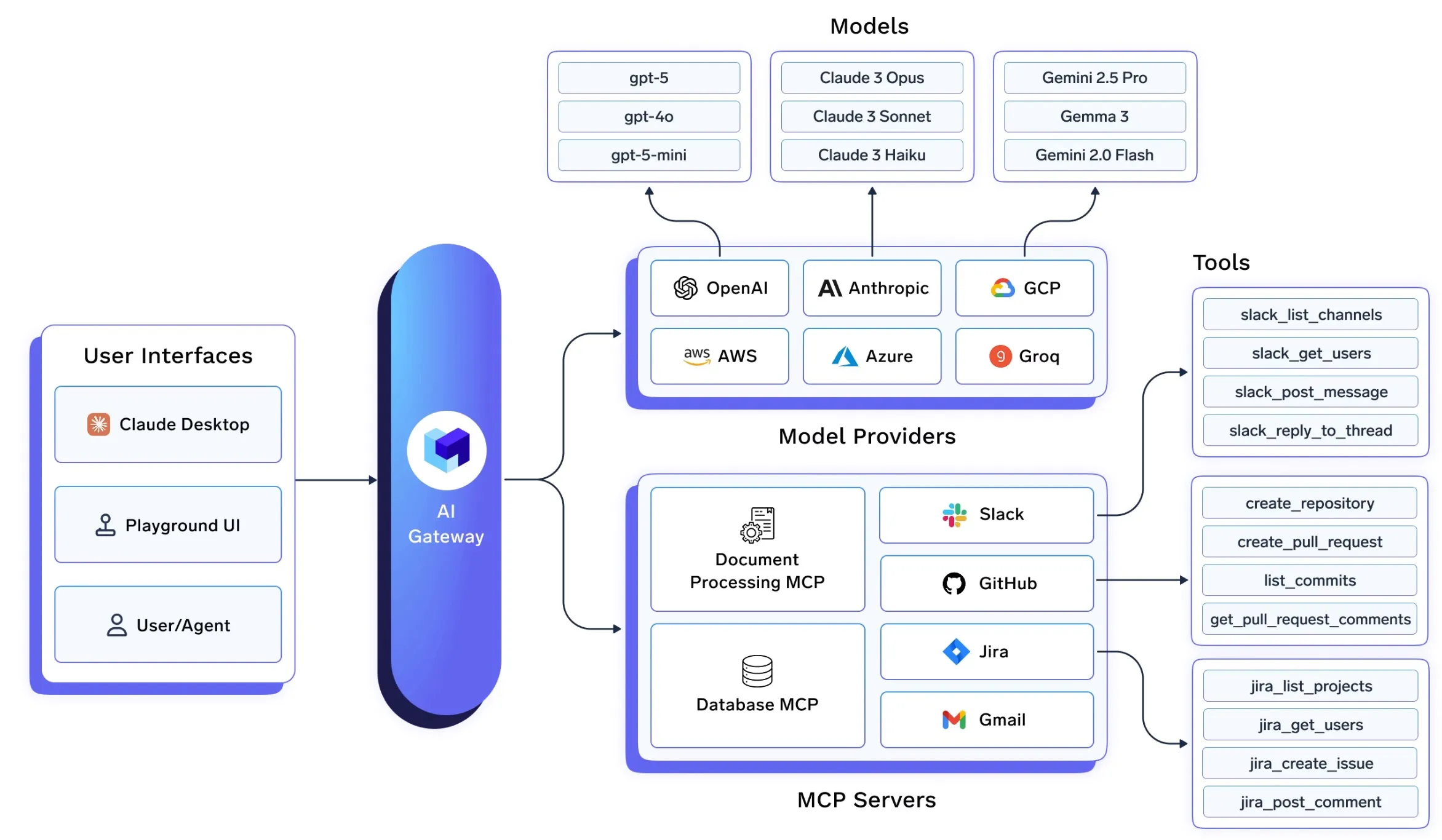
Truefoundry’s Agent Gateway embedded in AI gateway is a drop-in, enterprise-grade data plane that sits between agents, tools, and LLMs.
Its mandate is simple but powerful:
Connect every agent to every tool, securely, observably, and predictably: no matter the agent framework or environment. This foundation enables Multi agent MCP deployments, where dozens or even hundreds of agents coordinate through shared tools and governed protocol flows without creating operational chaos.
It becomes the connective tissue for all agentic communication:
Think of it as the Istio for AI agents, but purpose-built for the reality of MCP and A2A traffic.
1. Connect: Universal Interoperability Across Agents & Tools
Enterprises won’t standardize on one agent framework.
Truefoundry solves this through:
This is not generic API routing—it is the kind of agent-aware connection orchestration expected from the best agent gateway.
2. Secure: Guardrails, Authentication, Authorization & Policy

This is where Truefoundry becomes mission-critical for Agentic AI security.
It provides:
Agents cannot be allowed to “discover” tools in uncontrolled ways.
Truefoundry ensures:
This is what enterprises require before AI agents move into production.
3. Observe & Control: Full Lifecycle Visibility of Agentic Workflows
Agentic systems running across the best agentic AI platforms are dynamic and unpredictable.
You can’t govern what you can’t see.

Truefoundry adds:
This observability layer becomes the foundation for:
For developers, it feels like looking “inside the mind” of your agent system—step-by-step.
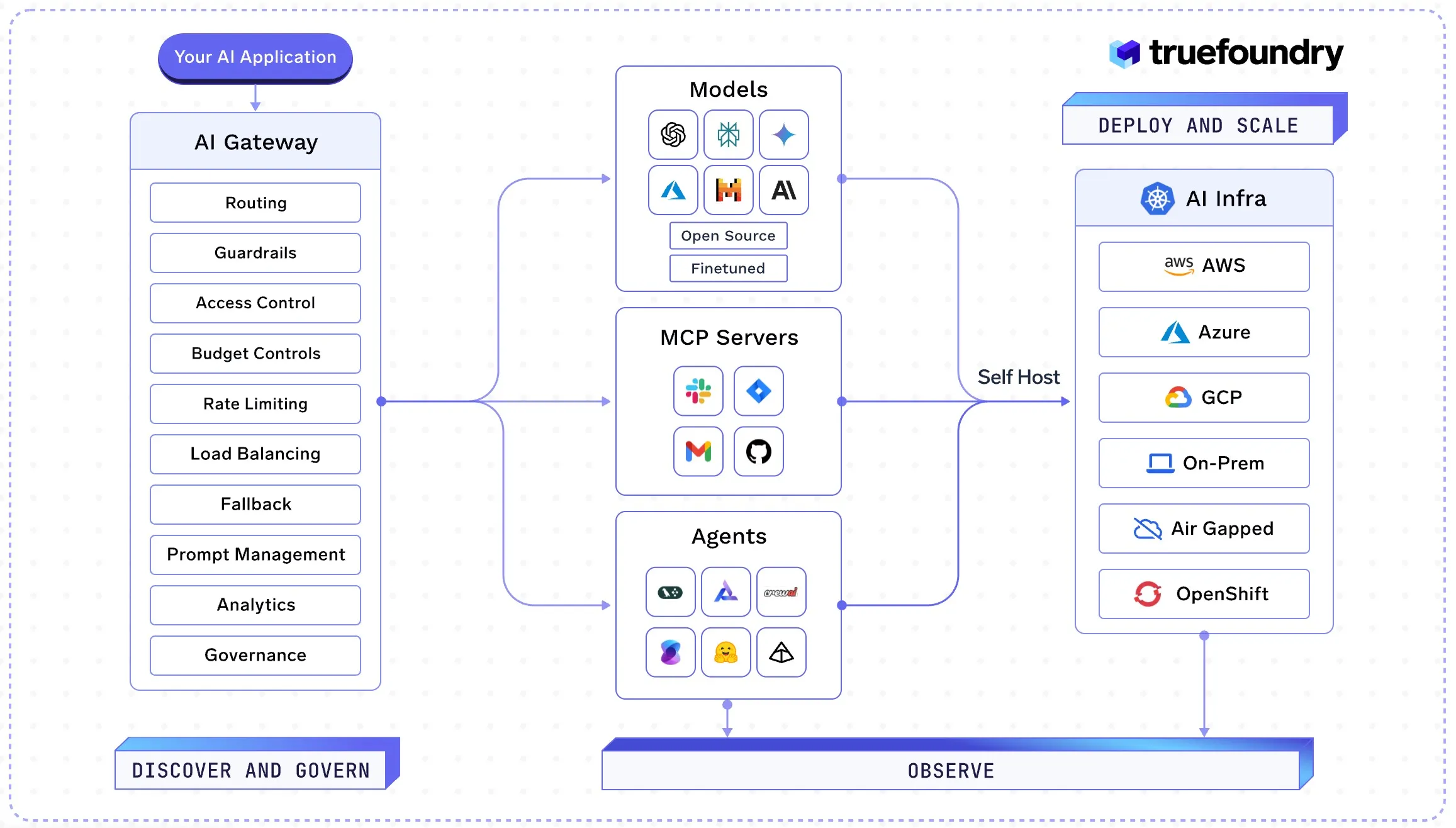
Truefoundry built its gateway as a stateful Rust-based data plane, not a repurposed proxy.
That matters for several reasons:
1. High throughput + memory safety = reliable at scale
Agent gateways maintain thousands of concurrent tool sessions.
Rust’s async runtime allows predictable memory usage while eliminating whole classes of security vulnerabilities.
2. Stateful multiplexing
Truefoundry tracks:
This enables one agent request to fan out across many backend tools, then reassemble results cleanly.
3. Bidirectional message handling
MCP/A2A supports server-initiated messages.
Truefoundry routes these correctly to the right agent session—even across distributed systems.
4. Protocol intelligence
The Gateway deeply understands:
This makes the gateway future-proof as agent protocols evolve.
Developers get:
Truefoundry removes 70% of the “infrastructure tax” developers pay today when building agent systems.
Executives get:
1. Security and governance baked in
No uncontrolled agent actions.
No opaque black boxes.
2. Faster time-to-production
Engineering teams don’t have to reinvent session routing, authentication, tracing, or governance.
3. Enterprise-wide standardization
Every LOB can adopt agents safely with multi-tenancy and fine-grained controls.
4. Lower operational risk
Truefoundry becomes the guardrail layer that protects the enterprise from:
5. A scalable operating model for AI systems
The gateway becomes the backbone for hundreds of agents working together across the bank or enterprise.
Just as API gateways became essential when microservices exploded, AI agent gateways will become foundational as enterprises deploy:
Agent-to-agent and agent-to-tool connectivity is the new “service mesh” problem—Truefoundry solves it with a purpose-built, secure, governed, stateful gateway.
AI agents promise exponential speed, autonomy, and intelligence.
But without the right connective tissue—secure, observable, policy-enforced communication—they remain prototypes.
Truefoundry’s AI Agent Gateway is the missing layer that transforms agentic systems from experiments into enterprise platforms.
It is the control plane that brings order, trust, reliability, and governance to AI agents at scale.
And for the first time, enterprises can run agentic applications with the same confidence they run mission-critical microservices.
TrueFoundry AI Gateway delivers ~3–4 ms latency, handles 350+ RPS on 1 vCPU, scales horizontally with ease, and is production-ready, while LiteLLM suffers from high latency, struggles beyond moderate RPS, lacks built-in scaling, and is best for light or prototype workloads.




The latest news, articles, and resources sent to your inbox
© 2026 All rights reserved.




.webp)









.png)
