April 2, 2026
|
5 min read


Updated: January 9, 2026


Blazingly fast way to build, track and deploy your models!
In a microservices architecture, we use DNS to find services. If I need the billing service, I call billing.svc.cluster.local. It’s simple because the relationship is static: Service A calls Service B.
In an Agentic Architecture, relationships are dynamic. You don't want your "Manager Agent" to hardcode a connection to finance-agent-v1. You want it to ask: "Find me a capability that can query Q3 revenue."
Sometimes that capability is a Tool (a direct SQL query via an MCP Server).
Sometimes that capability is another Agent (a reasoning engine that analyzes the SQL output).
To solve this, TrueFoundry introduces the Unified MCP & Agent Registry. It is a single catalog that treats Tools and Agents as discoverable, interoperable assets.
The AI agent registry acts as a unifying abstraction layer. It ingests disparate resources—Python scripts, LangGraph agents, Postgres Databases, SaaS APIs—and projects them all as standardized Capabilities.
To the orchestrator, a "Database" and a "Junior Analyst Agent" look identical: they are both just endpoints that accept a JSON schema and return a result.
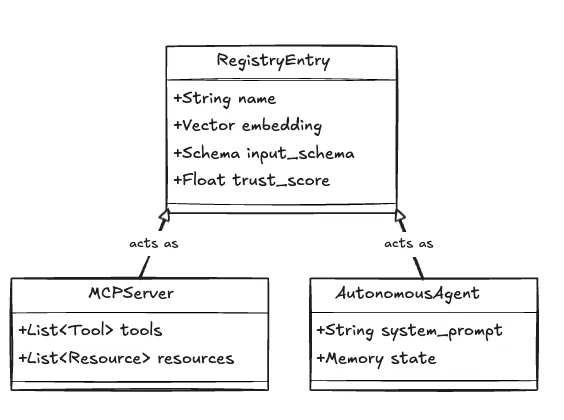
Fig 1: Agent Registry Entry Data Model
The biggest barrier to multi-agent collaboration is the interface mismatch. A LangGraph agent speaks "State Updates"; a CrewAI agent speaks "Tasks."
TrueFoundry standardizes this using the Model Context Protocol (MCP).
When you register an agent with the Gateway, the Registry automatically wraps it in an MCP Interface. This means your sophisticated "Financial Analyst Agent" looks exactly like a standard function call to the rest of the system.
This allows a "Manager Agent" to invoke a "Sub-Agent" just as easily as it invokes a Calculator—simplifying orchestration down to a single protocol.
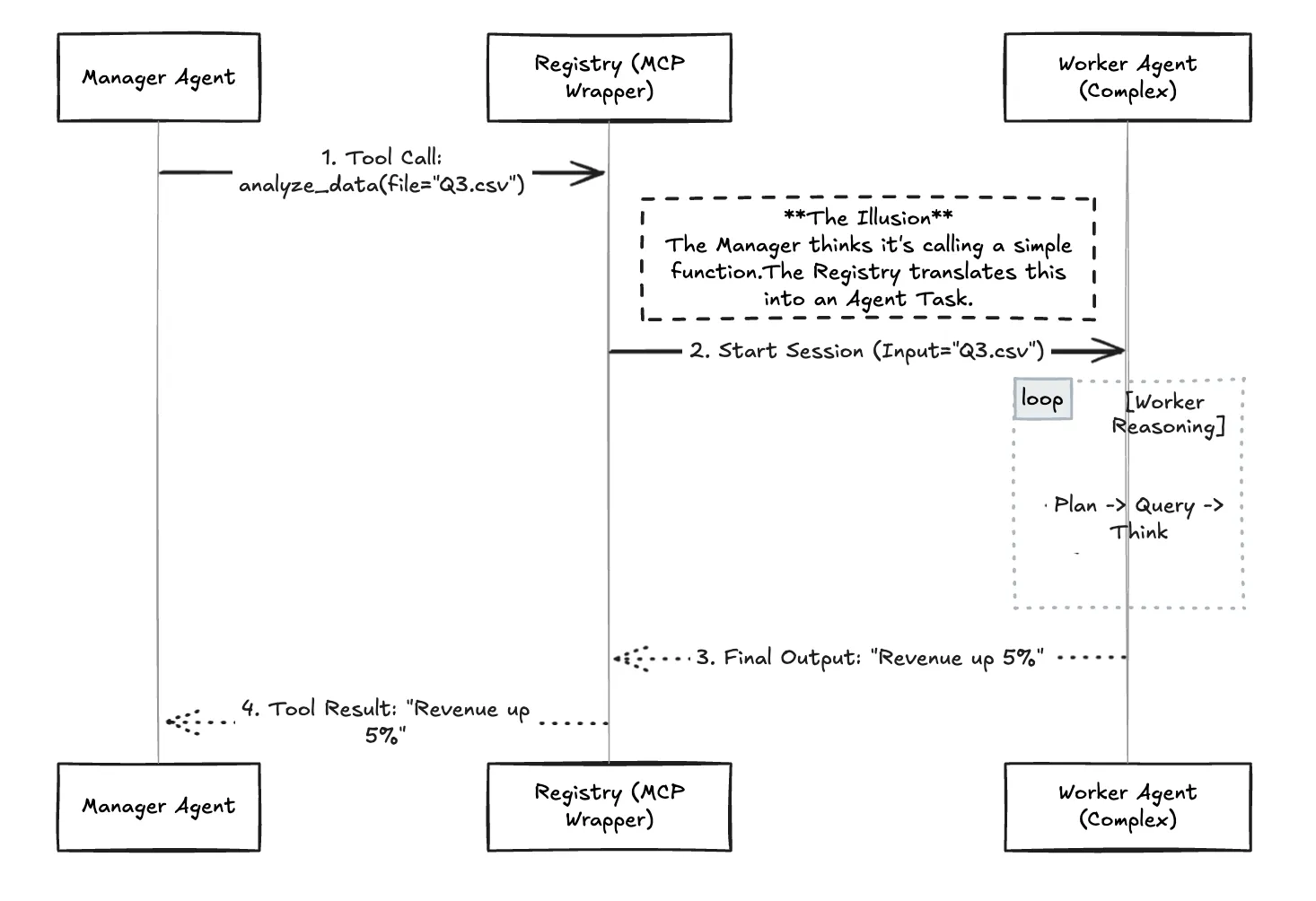
Fig 2: Agent-as-a-tool Example
How does an agent know which tool to use? It shouldn't need to know the name.
The Registry uses Vector Embeddings to map natural language intent to technical capabilities.
The Gateway returns both options. The calling agent can then decide: Do I need a raw metric (Tool), or a diagnosis (Agent)?
In a decentralized enterprise, you might have five different "Coding Agents" deployed by different teams. Which one should you use?
A static registry would just list them all. The TrueFoundry Registry is stateful. It connects to the ai gateway observability layer to track
the live performance of every asset, including success rates, latency, and evaluation scores.
You can configure Routing Policies directly in the Registry:
"For production code changes, ONLY route to agents with >90% Faithfulness scores on the latest Eval run."
This ensures that your orchestration layer isn't just connecting to available agents, but to competent ones.
As you scale to hundreds of agents and thousands of MCP tools, you risk a "Spaghetti Mesh" where every agent can call every tool. This is a security nightmare.
The Registry enforces Graph Topology. It acts as the "Org Chart" for your digital workforce.
This check happens at the Discovery Layer. When the Support Bot asks "Who can help me with payroll?", the Registry simply returns "No results found." You cannot attack what you cannot see.
The Unified MCP & Agent Registry is the backbone of the Cognitive Enterprise. By treating Agents and Tools as equal, discoverable citizens—and wrapping them in a unified security and observability layer—TrueFoundry allows you to compose complex, reliable workflows from disparate building blocks.
TrueFoundry AI Gateway delivers ~3–4 ms latency, handles 350+ RPS on 1 vCPU, scales horizontally with ease, and is production-ready, while LiteLLM suffers from high latency, struggles beyond moderate RPS, lacks built-in scaling, and is best for light or prototype workloads.



The latest news, articles, and resources sent to your inbox
© 2025 All rights reserved.


.webp)



.webp)
.webp)
.webp)
%20(1).webp)