January 9, 2026
|
5 min read

In traditional software engineering, if a system fails, you look at the stack trace. It points you to line 42: NullPointerException. The NPE error is deterministic, reproducible, and logical.
In Agentic Engineering, failure is silent and hallucinated. An agent doesn't throw an exception; it confidently lies. It might say, "I have successfully updated the database," when it actually did nothing. Or it might get stuck in a reasoning loop, obsessing over a minor detail while the user waits.
You cannot debug this with standard logs (console.log). You need a Flight Data Recorder.
The TrueFoundry Agent Gateway includes a comprehensive Observability Module designed specifically for probabilistic systems. It records the Chain of Thought (CoT) or Tree of Thoughts (ToT) , creating an immutable, replayable history of every decision your digital workforce makes.
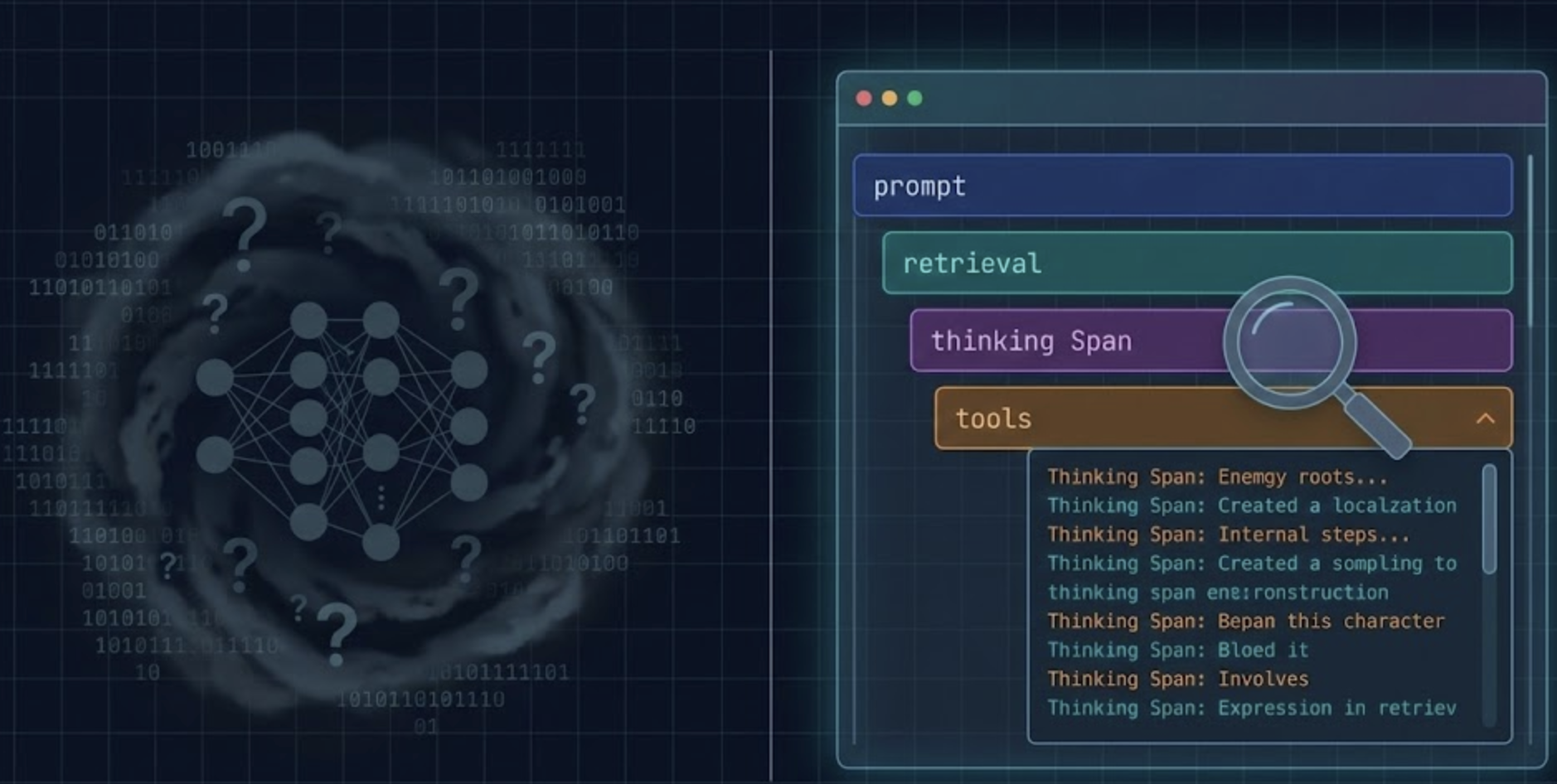
When an LLM makes a decision, the "reasoning" is often hidden in the transient state between API calls.
Why? Did the API fail? Did the prompt forbid it? Did the model hallucinate a policy restriction? Without capturing the intermediate scratchpad—the agent's internal monologue—you are flying blind.
To understand the necessity of this system, let’s look at a high-stakes scenario: Automated Loan Processing.
The Incident: A loyal customer with a high credit score applies for a mortgage. The "Loan Agent" instantly rejects the application with the reason: "Applicant does not meet residency requirements." The customer is furious. The bank's engineers are baffled—the customer lives in the same house for 10 years.
Debugging Without a Recorder: The engineers check the logs. They see the input (application PDF) and the output (Rejection). They check the code—the "Residency Check" function looks fine. They try to reproduce it with a test case, but the stochastic model accepts the test case. They cannot fix what they cannot see.
Debugging With the TrueFoundry Recorder: The team pulls up the Trace ID for that specific interaction. They don't just see the IO; they see the Cognitive Trace:
The Fix: The bug wasn't in the code; it was in the Reasoning Chain. The model hallucinated a correlation between "blue background" and "non-US passport." With this insight, the engineers update the System Prompt: "Ignore visual artifacts or colors in the document when determining residency. Rely ONLY on the text content."
The bug is squashed.

Fig 1: The Bug that is from the Reasoning Chain
We treat cognition as a distributed trace. The Gateway integrates with OpenTelemetry (OTel) to visualize the agent's workflow as a waterfall of spans.
We introduce semantic conventions for GenAI spans:
This allows you to visualize latency bottlenecks. Is the agent slow because GPT-4 is lagging (Inference Latency)? Or because the SQL query took 10 seconds (Tool Latency)?
For regulated industries (Finance, Healthcare), "The AI did it" is not a valid legal defense. Under the EU AI Act and SOC2 requirements, you must explain why an AI decision was made.
The Gateway implements an Async Audit Pipeline.
If an auditor asks, "Show me why this medical claim was denied on Dec 15th," you can pull the exact, tamper-proof transcript.
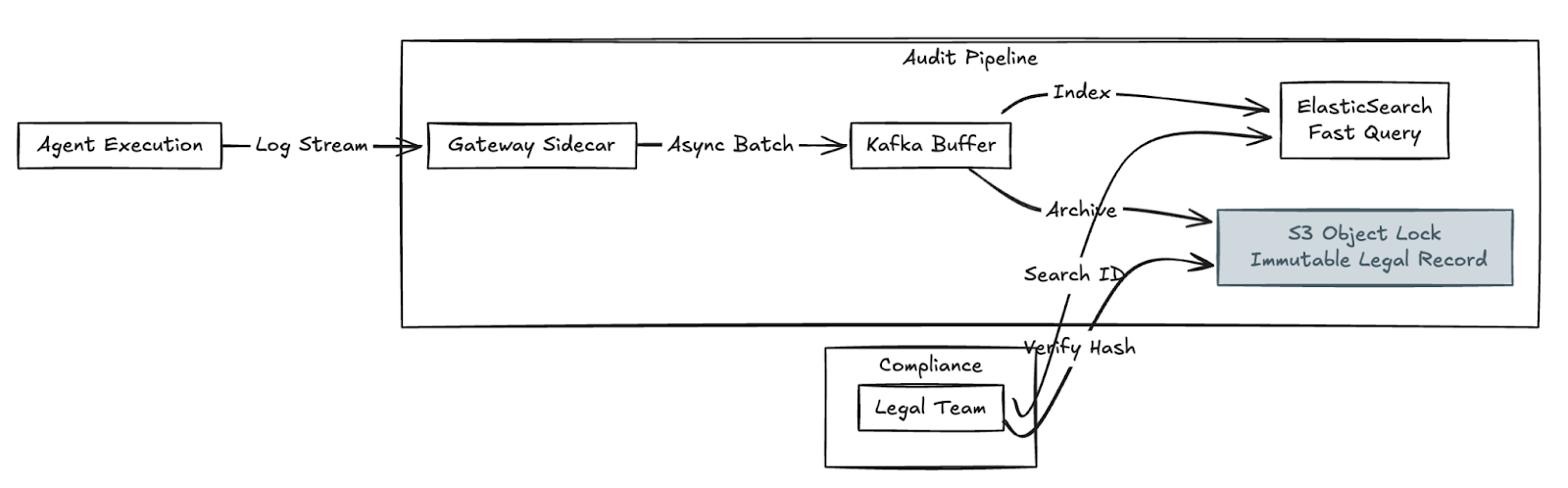
Fig 2: Audit Pipeline Illustration
Observability is useless if you can't act on it. The Recorder enables a powerful workflow called Counterfactual Debugging.
Because we captured the entire state (System Prompt + Context + User Input) at the moment of failure, the Gateway allows you to Fork the Session. You can replay the exact same request, but tweak one variable:
You can run these variations in parallel (Shadow Mode) against the recording to verify the fix before deploying it to production.
In the deterministic world, we monitor uptime. In the agentic world, we must monitor alignment. The Black Box Recorder turns the chaotic, probabilistic nature of AI into a structured, observable, and accountable process. It provides the visibility engineers need to debug hallucinations and the assurance compliance teams need to sign off on deployment.
Blazingly fast way to build, track and deploy your models!
TrueFoundry AI Gateway delivers ~3–4 ms latency, handles 350+ RPS on 1 vCPU, scales horizontally with ease, and is production-ready, while LiteLLM suffers from high latency, struggles beyond moderate RPS, lacks built-in scaling, and is best for light or prototype workloads.



The latest news, articles, and resources sent to your inbox
© 2025 All rights reserved.