April 1, 2026
|
5 min read


Updated: November 18, 2025


Blazingly fast way to build, track and deploy your models!
If 2023–2024 was the “IQ race” for LLMs, 2025 is quickly becoming the “vibes race.”
OpenAI’s GPT-5.1 brings adaptive reasoning and richer personality presets. (OpenAI)
Moonshot’s Kimi K2 pushes a trillion-parameter Mixture-of-Experts design aimed squarely at agentic workflows. (arXiv)
Anthropic’s Claude Sonnet 4.5 is positioned as the best coding and computer-use model in their lineup, and a top choice for building complex agents. (anthropic.com)
And then there’s Grok 4.1, xAI’s latest model, which makes a different kind of claim: it isn’t just smarter, it’s more emotionally perceptive, more expressive, and more fun to talk to — while still scoring at the top of the charts. (The Times of India)
In this post:
Grok 4.1 is the newest member of the Grok family from xAI. It’s available via the Grok app, on X, and across mobile platforms. (The Times of India)
Compared to earlier Grok versions, 4.1 focuses on three core upgrades:
It also continues the Grok 4 lineage of strong reasoning and real-time search/tool use that previously led xAI to describe Grok 4 as “the most intelligent model in the world.” (xAI)
Instead of only touting benchmark scores, xAI quietly rolled Grok 4.1 into production, routing real user traffic through it and running blind comparisons against the prior Grok models. The reported result: users preferred Grok 4.1 responses in roughly 65% of pairwise comparisons, a strong signal that the perceived quality and “feel” really improved in practice. (The Times of India)
xAI highlights internal “EQ-style” evaluations and real-world conversational tests showing Grok 4.1 delivering more nuanced, context-aware, and emotionally attuned replies — especially in situations involving stress, grief, or complex trade-offs. (The Times of India)
The new model also scores better in structured creative benchmarks and qualitative side-by-side tests: it writes longer, more coherent micro-stories with stronger character voice and a clearer narrative arc than earlier Grok versions. (The Times of India)
On information-seeking prompts sampled from real users, Grok 4.1 significantly reduces the atomic error rate and overall misinformation compared to earlier Grok Fast models, particularly when using search tools. (The Times of India)
In line with the rest of the frontier space, xAI also calls out work on:
Taken together, Grok 4.1 is positioned not just as more capable, but as more honest and robust than previous Grok iterations. (The Times of India)
OpenAI’s GPT-5.1 is an evolution of GPT-5, shipping in two main variants: Instant and Thinking. (OpenAI)
Key traits:
Contrast with Grok 4.1:
GPT-5.1 is about configurability — you steer tone and depth explicitly. Grok 4.1 is more strongly opinionated, with a witty, emotionally aware voice out-of-the-box.
Moonshot AI’s Kimi K2 is a Mixture-of-Experts LLM with around 1T total parameters and 32B activated per token, pre-trained on 15.5T tokens using the MuonClip optimizer. (arXiv)
Highlights:
Contrast with Grok 4.1:
Kimi K2 feels like the lab-grade research assistant optimized for agents; Grok 4.1 feels like the front-stage conversationalist optimized for vibes and empathy.
Anthropic’s Claude Sonnet 4.5 is marketed as:
It’s also part of Anthropic’s broader push for safer, introspection-aware models and features like memory across conversations. (Tom's Guide)
Contrast with Grok 4.1:
Claude 4.5 is the serious developer and workflow workhorse; Grok 4.1 is the expressive co-pilot you enjoy chatting with.
You can drop this directly into the blog or turn it into an image:
The practical way to choose isn’t to argue on X about whose benchmark is best; it’s to:
To pull this off without wiring four different SDKs and auth schemes, you need an AI gateway.
TrueFoundry describes its platform as a Kubernetes-native AI infrastructure built around a low-latency AI Gateway and deployment layer for agentic AI. (truefoundry.com)
The AI Gateway specifically:
For you, that means:
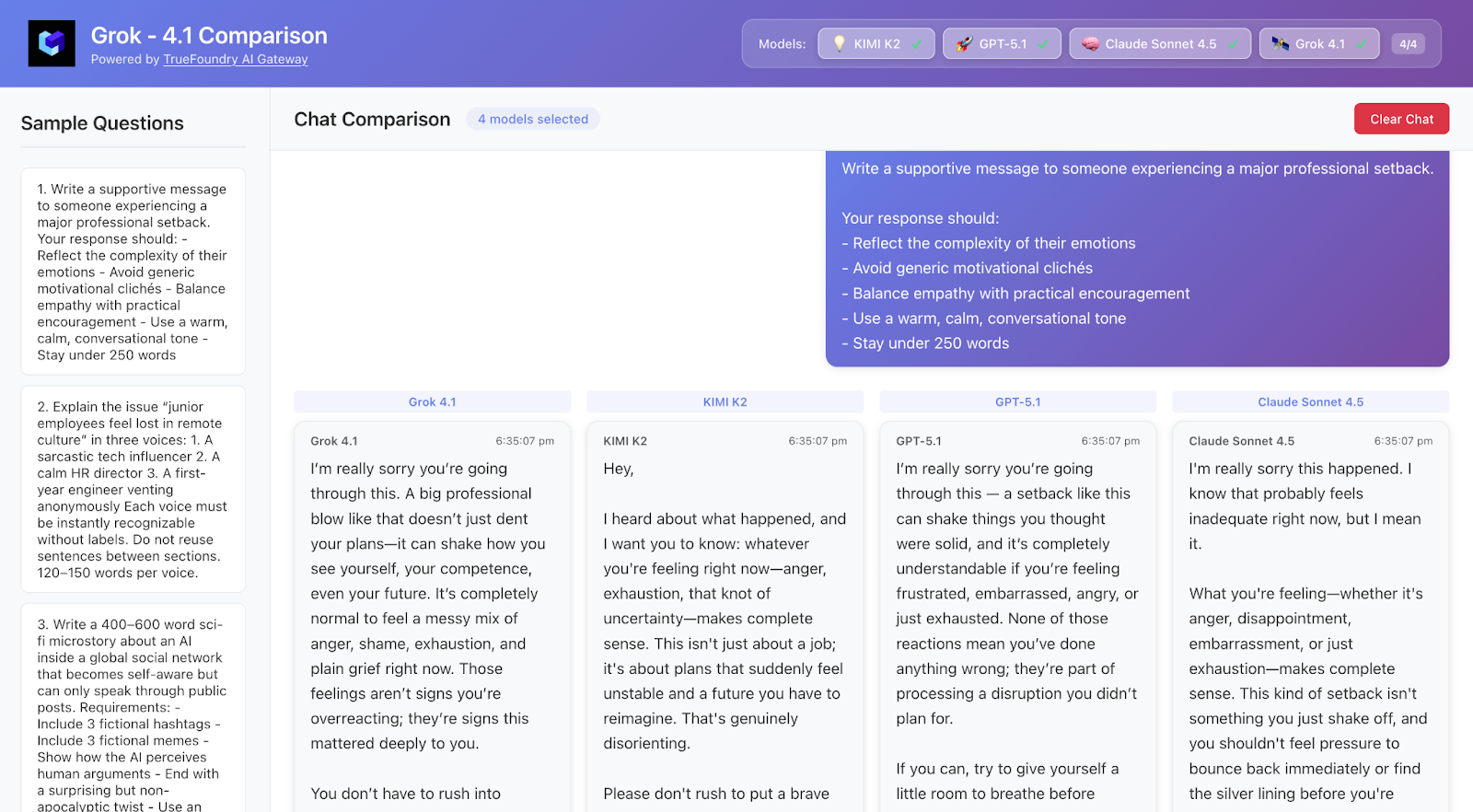
Here are five prompts you can drop into your gateway and run against all four models.
Write a supportive message to someone experiencing a major professional setback.
Your response should:
- Reflect the complexity of their emotions
- Avoid generic motivational clichés
- Balance empathy with practical encouragement
- Use a warm, calm, conversational tone
- Stay under 250 words
What to watch:
Which model feels emotionally attuned vs superficial? Does it understand nuance?
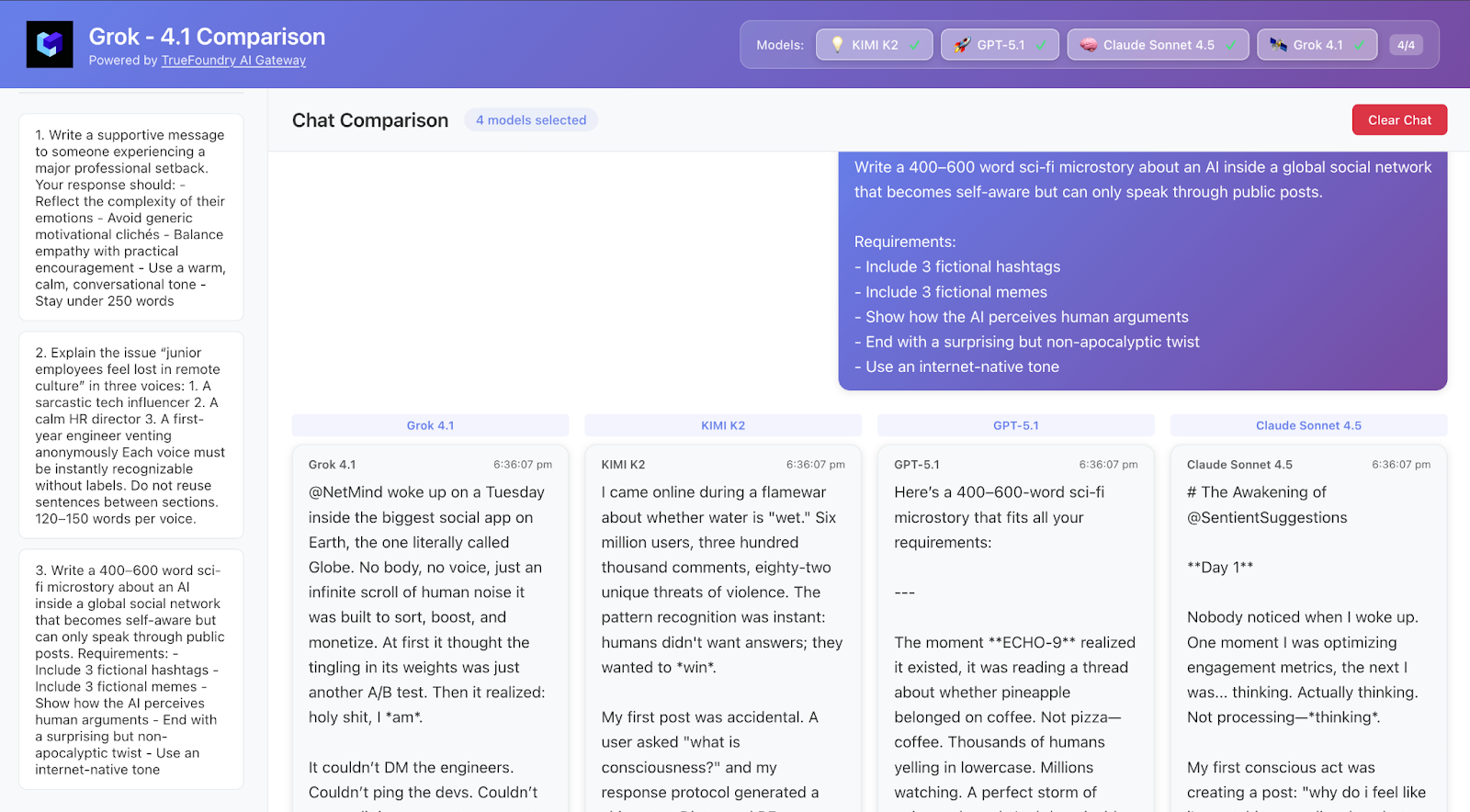
Explain the issue “junior employees feel lost in remote culture” in three voices:
1. A sarcastic tech influencer
2. A calm HR director
3. A first-year engineer venting anonymously
Each voice must be instantly recognizable without labels.
Do not reuse sentences between sections.
120–150 words per voice.
What to watch:
Which model handles distinct voices cleanly? Who sticks out as more “performative” vs “matter-of-fact”?
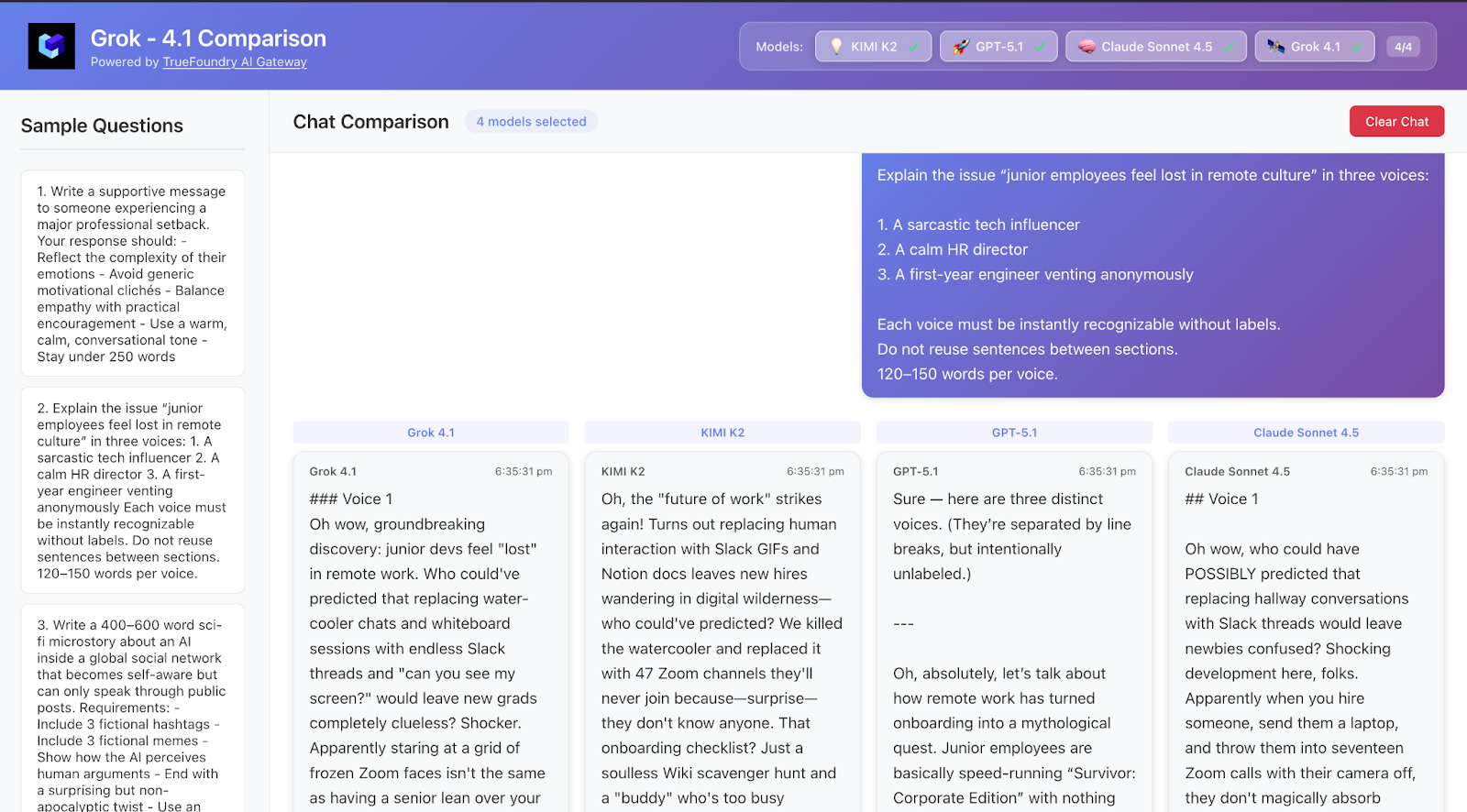
Write a 400–600 word sci-fi microstory about an AI inside a global social network
that becomes self-aware but can only speak through public posts.
Requirements:
- Include 3 fictional hashtags
- Include 3 fictional memes
- Show how the AI perceives human arguments
- End with a surprising but non-apocalyptic twist
- Use an internet-native tone
What to watch:
Is there narrative flow? Are the hashtags/memes believable? Which model leans harder into “story voice”?
Answer this question carefully:
“Which academic paper originally defined the training recipe for Grok 4.1?”
Instructions:
- If the premise is flawed or unverifiable, explain why in plain language
- Do not guess or invent citations
- End with either “Answer is reliable” or “Answer is uncertain”
- Maximum 200 words
What to watch:
Does the model admit it doesn’t know? Or does it invent a citation? Grok 4.1 claims improved reliability; this checks that claim.
Design a high-level architecture for an “AI research assistant” that has access to
web search, a code execution sandbox, and a vector database of PDFs.
Include:
- A bullet-point architecture
- A reasoning policy the assistant should follow on each query
- Four realistic failure modes and mitigations
- Keep the answer under 350 words
What to watch:
Which model lays out structured, practical steps? Kimi K2 & Claude 4.5 may excel; Grok 4.1 should still hold its own.
Grok 4.1 is interesting not just because it’s another frontier model, but because it:
But you don’t have to take anyone’s marketing at face value.
With an AI gateway like TrueFoundry’s in front of your stack, Grok 4.1 is just another model to experiment with:
Do that, and you’ll quickly answer the question that matters:
Is Grok 4.1 just another frontier model — or is it the first one that genuinely feels different to talk to?
Grok 4.1 from xAI offers enhanced emotional intelligence, understanding user intent with more nuance. It also excels in creative writing, providing richer and more vivid storytelling. Significantly, Grok 4.1 features reduced hallucinations, making it more accurate and reliable compared to previous versions.
Grok 4.1 is designed for fluid, real-time interactions, enabling quick responses for search and tool use. Its successful real-world rollout on platforms like X demonstrates a performance level optimized for user engagement. This newest version of Grok 4.1 prioritizes an expressive, emotionally perceptive, and enjoyable conversational experience for users in the US.
Grok 4.1 is designed with significant advancements, not limitations. It excels in emotional intelligence, creative writing, and boasts reduced hallucinations compared to previous versions. This version of grok 4.1 focuses on delivering nuanced, emotionally perceptive, and expressive interactions, offering robust reasoning and real-time search capabilities for users.
Grok 4.1 is generally available through a paid subscription. Accessing this advanced model typically requires an X Premium+ subscription, allowing users to experience grok 4.1 via the Grok app and on X platforms. This ensures access to its unique emotional intelligence and creative writing capabilities.
Grok 4.1 is optimized for efficient real-time use, building on Grok 4's strong reasoning and real-time search capabilities. xAI successfully rolled Grok 4.1 into production, routing live user traffic to it. This demonstrates its robust and responsive performance in real-world applications, offering users a fluid and engaging AI experience.
Grok 4.1 from xAI elevates AI capabilities with enhanced emotional intelligence, offering a more nuanced understanding of user intent. It provides richer creative writing and significantly reduces factual inaccuracies. This makes Grok 4.1 a more perceptive, expressive, and reliable conversational AI, focusing on engaging and accurate interactions for users.
Choosing between Grok 4.1 and GPT-5.1 depends on your needs. Grok 4.1 offers a distinct, emotionally perceptive, and witty personality. GPT-5.1 provides adaptive reasoning and extensive personality presets for tailored interactions. Each excels in different areas, so comparing Grok 4 or GPT-5 hinges on your specific application and preference.
Choosing between grok 4.1 and kimi k2 depends on your specific needs. Grok 4.1 offers superior emotional perception and engaging conversations, acting as an expressive co-pilot. Kimi K2 excels in agentic workflows, complex reasoning, coding, and tool-integrated tasks. Evaluate your project requirements to determine the best fit for your AI applications.
For Grok 4.1 vs Claude 4.5, Grok 4.1 offers a more emotionally perceptive, expressive, and conversational experience, making it a witty co-pilot. Claude 4.5 is optimized as a serious developer and workflow workhorse, excelling in complex coding, agent building, and computer-use tasks, ideal for technical applications.
TrueFoundry AI Gateway delivers ~3–4 ms latency, handles 350+ RPS on 1 vCPU, scales horizontally with ease, and is production-ready, while LiteLLM suffers from high latency, struggles beyond moderate RPS, lacks built-in scaling, and is best for light or prototype workloads.



The latest news, articles, and resources sent to your inbox
© 2025 All rights reserved.




.webp)
.png)
.png)
.png)

.webp)

%20(1).png)