January 7, 2026
|
5 min read

If 2024 was ignition into orbit, 2025 was the year we caught a gravitational slingshot. In every great space mission, a slingshot depends on two things:
a powerful external gravity source, and enough internal thrust to actually reach it.
For us, the rapidly accelerating demand for AI Gateways became that gravitational force. Our Series A was the internal thrust — giving us the engineering depth and GTM readiness to reach escape velocity and enter the right orbit to harness it.
Here’s what the slingshot looked like:
Velocity enablement (Series A) → Reaching the inflection orbit (AI Gateway) → Gravity assist (Exploding demand) → Spaceship (TrueFoundry) accelerates forward.
While this may read like a single heroic maneuver powered by one bold spark, the reality of building a space mission is far more intricate. Slingshots don’t happen by luck — they are the result of thousands of precise calculations, relentless preparation, and countless course corrections. 2025 wasn’t magic; it was the coming together of engineering discipline, customer partnership, GTM conviction, and an extraordinary amount of persistence and learning. And that’s what we reflect on below — starting with where 2024 left us.
In 2024, we partnered with multiple Fortune 500 enterprises and saw agentic applications begin to deliver real, measurable business value — often creating nine-figure impact. The potential for impact was no longer theoretical; it was undeniable. As we noted in our last year-end review, this also marked the beginning of our journey toward a world of “AI managed by AI,” with TrueFoundry becoming increasingly agentic by design.
But as we went deeper, two clear realities emerged:
These insights directly shaped our most important investments in 2025:
2025 was a defining year for TrueFoundry. Net new revenue doubled — or more — quarter over quarter, and Fortune 500 enterprises across Payments, Semiconductors, Telecommunications, Security, Chip Manufacturing, Pharma, Healthcare, and Data infrastructure trusted TrueFoundry to power their most critical production-grade agentic applications. Let’s zoom into the defining themes of the year.
Why this mattered in 2025
One of the most defining themes of 2025 was the rapid rise of the AI Gateway as a core piece of enterprise AI infrastructure. Over the last few months alone, we saw inherent demand for AI Gateways skyrocket. Today, roughly 10% of enterprises actively use a gateway, and over the next three years this is expected to grow to nearly 70%. What was once viewed as optional infrastructure quickly became foundational.
The assumption that broke
This shift happened because the industry — including us — underestimated the problem. Gateways were initially assumed to be thin, undifferentiated proxy layers that sat in the critical path of LLM requests and were best built in-house. Reality proved otherwise.
As enterprises moved from experimentation to production, the gateway surfaced as a deeply complex control plane — one that must handle constantly changing model APIs, centralized organizational controls, security policies, governance, observability, and reliability at scale.
We saw this shift firsthand as customers went from “we’ll never use an external gateway” to running their most critical production applications through ours within months.
Why the complexity kept expanding
At the same time, the scope of what needed to be governed expanded dramatically. LLM access alone was no longer sufficient. As MCP gained traction, enterprises struggled with authentication and authorization across a growing number of servers — naturally pulling this responsibility into the gateway. As agent-to-agent interactions (A2A) began to emerge, it became clear that agents themselves needed to be connected, observed, and governed through the same control plane. The logical evolution followed: LLM Gateway → MCP Gateway → Agent Gateway, culminating in what we now call the AI Gateway.
How we think about it today
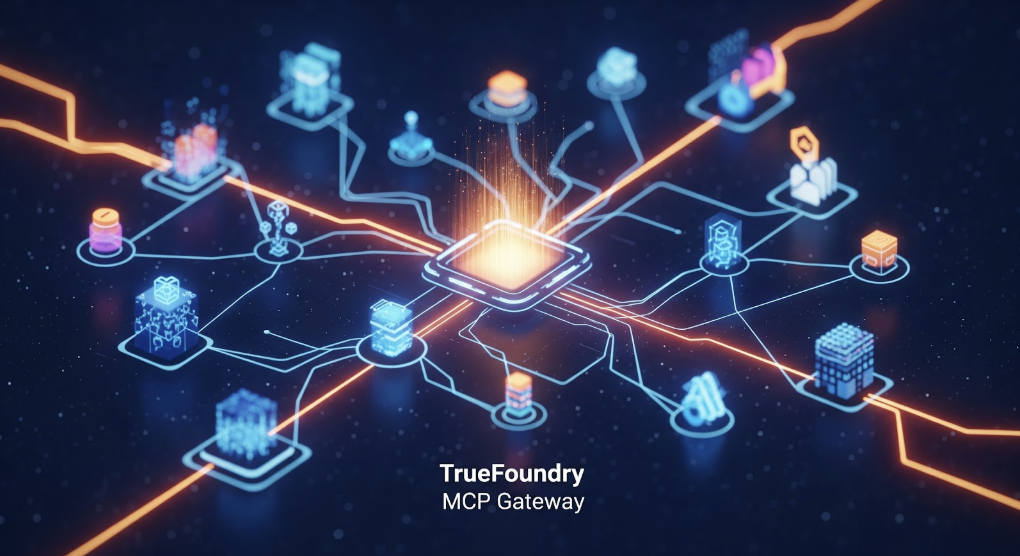
Today, we think about this clearly and simply. TrueFoundry provides an enterprise-grade AI Gateway that encompasses an LLM Gateway, MCP Gateway, and Agent Gateway — enabling enterprises to connect, observe, and govern agentic AI workloads across providers from a single control plane. Our AI Gateway helps enterprises stay secure, efficient, and future-safe while building increasingly autonomous systems — whether deployed as SaaS, on-prem, or in air-gapped environments.
As the AI Gateway emerged as the control plane for governing agentic systems, another reality became clear. Connecting, observing, and governing AI was only one part of the equation. Enterprises also needed a reliable, enterprise-native way to run these systems in production — on infrastructure they already trusted. This naturally led to our second theme of 2025.
Bringing agentic systems to the enterprise stack
As the agentic ecosystem exploded, enterprises needed a reliable execution layer to run this fast-moving, often chaotic ecosystem on familiar and trusted infrastructure. AI Deploy is that execution layer, enabling teams to deploy model inference, LLM fine-tuning, MCP servers, and agents as standard Kubernetes applications — directly on existing enterprise stacks.
Designed for a sovereign, hybrid, multi-cloud world
2025 also marked a strong shift toward Sovereign AI. Data residency, geopatriation, and cost-efficient AI workloads running on in-house data centers became increasingly important.
AI Deploy made it possible to adopt cutting-edge agentic systems without abandoning enterprise constraints.
UI-native, code-first by design
Another pattern became clear: enterprises needed simplicity without loss of control.
AI Deploy became the execution layer that allowed agentic systems to move from concept to production — cleanly, securely, and at scale.
As the AI Gateway emerged as the control plane for enterprise AI, and AI Deploy enabled agentic workloads to run on existing enterprise stacks, one thing became clear: infrastructure alone is not enough. Enterprises weren’t just asking how to build agentic systems — they were under pressure to deliver real business outcomes, often under tight timelines and high regulatory scrutiny. As a result, we doubled down on our Enterprise Outcomes strategy.
From experiment to strategy
What started as an experiment in 2024 became a full-blown strategy in 2025. We built a dedicated leadership team to run Enterprise Outcomes as a business and expanded our team of GenAI researchers to work closely with customers on their most critical AI initiatives.
Co-building real applications
Through Enterprise Outcomes, we co-developed industry-defining, production-grade agentic applications across healthcare, semiconductors, financial services, and telecommunications — focused not on demos or pilots, but on measurable business impact.
A compounding loop with the platform
We also observed a powerful flywheel take shape. As more use cases moved into production through Enterprise Outcomes, adoption of our deployment platform deepened. And as more of the platform was deployed, building and scaling new use cases became significantly easier. Each reinforced the other, creating a compounding expansion loop that defined how we worked with enterprises in 2025.
By the end of 2025, AI Gateway, AI Deploy, and Enterprise Outcomes had converged into a single operating stack — one that connects and governs Agentic systems, runs them at enterprise scale, and turns intelligent capability into real-world outcomes.
One of the clearest signals that this stack was resonating came from the market itself. Throughout 2025, we began seeing a strong inbound pull from enterprises — both in volume and in urgency.
This momentum showed up directly in our numbers: strong quarter-over-quarter revenue growth, faster sales cycles, and a growing list of new enterprise logos. What once required heavy education increasingly became a conversation about how fast customers could get to production.
Behind this momentum was a team that scaled with purpose, ownership, and belief.
One of the things I’m most proud of at TrueFoundry is how the team from the earliest days continued to believe deeply in the mission and grow alongside the company. As the team tripled in size during 2025 — across Sales, Marketing, Enterprise Outcomes, and Engineering — that early group played a huge role in shaping the culture and welcoming new teammates into it. Midway through the year, we had the chance to come together for a truly special team offsite in the Maldives. Sharing a few moments from that here.


2025 marked the moment our vision, execution, and market pull aligned, turning years of preparation into sustained forward momentum.
As we look ahead to 2026, one belief continues to guide our direction: AI systems will increasingly be managed by AI. Humans will move up the abstraction layer — from operating every step of a system to defining intent, constraints, and outcomes — while intelligent systems take on execution.
We see two structural shifts shaping the next generation of software.
From enabling developers to enabling every knowledge worker.
The last decade of software was about empowering developers — one of the most powerful personas in technology — through an explosion of devtools and SaaS. The next few years will be about empowering every knowledge worker. GenAI has fundamentally expanded what software can do, giving rise to a new class of systems that allow people to build, reason, and operate complex workflows without needing to be traditional programmers.
From human-in-the-loop to human-out-of-the-loop.
We are beginning to move from AI systems that assist humans to systems that operate autonomously. In this world, agents don’t just respond — they plan, build, deploy, and run end-to-end workflows. Software will increasingly be built for agents, with humans setting direction and guardrails rather than providing continuous intervention.
As we move into 2026, our goal is to enable everyone — humans and AI systems alike — to build, deploy, and scale intelligent systems effortlessly and optimally through intuitive compute interfaces designed for both people and machines.
Here’s to building intelligent systems that can truly run themselves — and to the teams bold enough to make them real. We’re deeply grateful to our team, customers, and investors for their trust and support, and we step into 2026 with clarity, conviction, and optimism.
The gravity assist of 2025 gave us speed. 2026 is about direction — and distance. Happy New Year!
Blazingly fast way to build, track and deploy your models!
TrueFoundry AI Gateway delivers ~3–4 ms latency, handles 350+ RPS on 1 vCPU, scales horizontally with ease, and is production-ready, while LiteLLM suffers from high latency, struggles beyond moderate RPS, lacks built-in scaling, and is best for light or prototype workloads.


The latest news, articles, and resources sent to your inbox
© 2025 All rights reserved.